Inside the MSO
Most ophthalmologists have heard the term MSO. Very few know what one actually does on a Tuesday morning.
The concept gets thrown around in acquisition conversations and LinkedIn posts about practice transitions, but the specifics are vague. "We handle the business side" is what every management services organization says. The question is what that means in practice, because the gap between what a physician thinks they're outsourcing and what they're actually outsourcing determines whether the relationship works or whether it creates more problems than it solves.
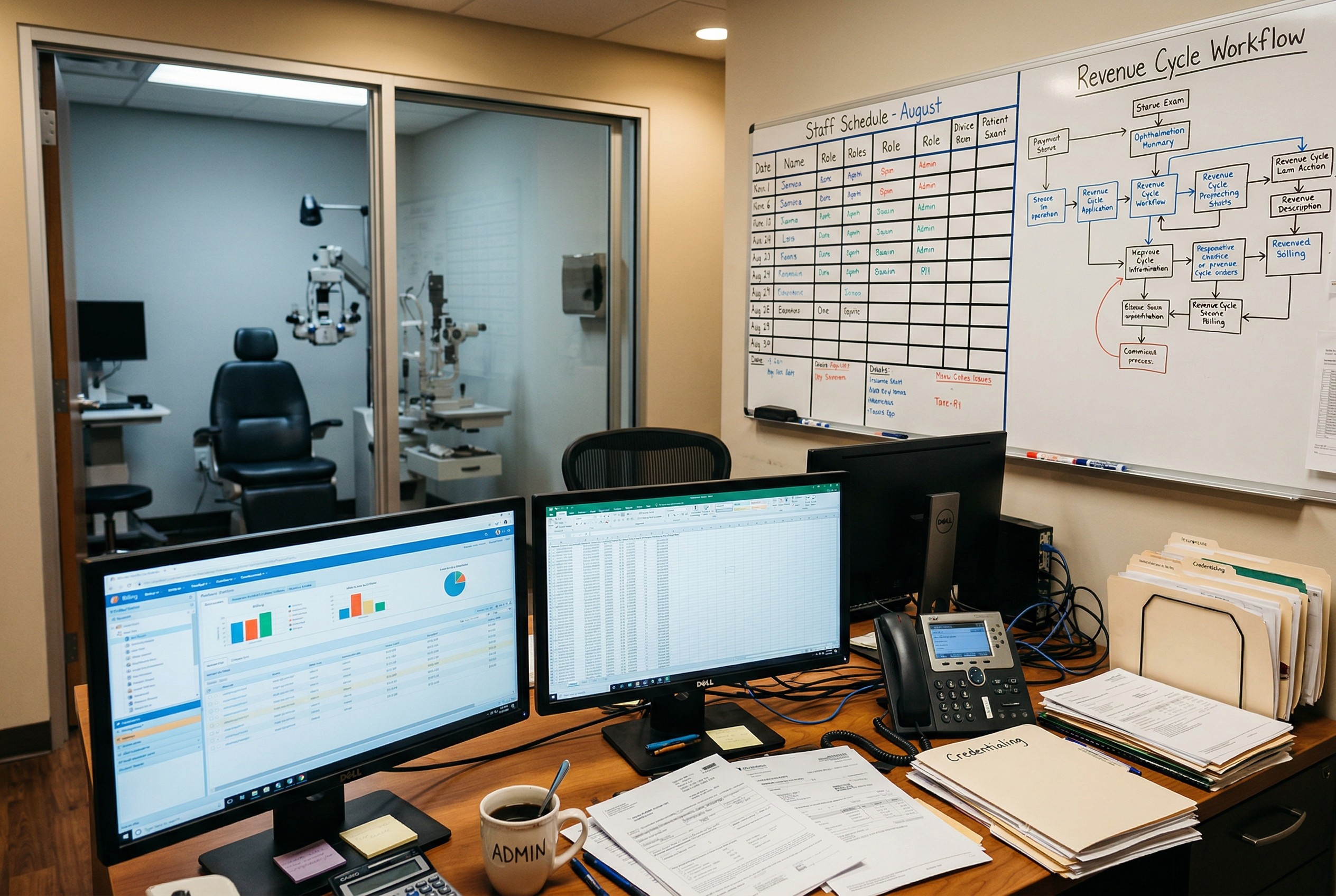
Here's what happens inside an ophthalmology practice every day that has nothing to do with medicine.
The Overhead Nobody Talks About
The AAO/AAOE AcadeMetrics Benchmarking Survey, analyzed by BSM Consulting, puts the typical ophthalmology practice overhead ratio between 55% and 67% of net revenue. Top performing practices run at 52%. The average sits at 58%. That means for every dollar a practice collects, only $0.33 to $0.48 goes to the physician. The rest goes to staff, rent, equipment, billing, insurance, compliance, marketing, and technology.
A June 2025 MGMA Stat Poll found that 90% of medical groups reported year to date operating costs higher than the same period in 2024, with an average increase of 11.1%. Staffing costs alone account for roughly 25% of total practice revenue according to MGMA data. Add in the rest of the operational expenses and the physician is running a mid sized business that happens to involve eye surgery.
The physician didn't go to medical school to manage a mid-sized business. They went to learn how to save someone's vision.
Where Physician Time Actually Goes
The AMA's 2024 National Physician Comparison Report found that physicians work an average 57.8 hour week. Only 27.2 of those hours go to direct patient care. Another 13 hours go to indirect clinical work like documentation, order entry, and reviewing test results. And 7.3 hours go to pure administrative tasks that have nothing to do with patients at all.
That's not the full picture. The same AMA data showed 22.5% of physicians spend 8 or more additional hours per week on EHR work outside of normal hours. After dinner, before the kids go to bed, the physician opens the laptop and finishes charting. The industry calls this "pajama time." It costs nothing on the P&L statement but it costs everything in physician well-being.
For ophthalmology specifically, the numbers are even more aggressive on the administrative side. A 2024 study in JAMA Ophthalmology tracked 2,225 prior authorization requests across 9 retina practices and found that each request consumed a median of 100 minutes of clinic staff time. Over 96% of those authorizations were ultimately approved. The practices collectively spent 1,742 staff hours fighting for treatments that were going to be approved anyway.
That's the kind of work an MSO absorbs entirely.
Billing Is a Business Within the Business
Outsourced medical billing for a small ophthalmology practice runs approximately 8 to 10% of collected revenue, according to AMA survey data reported by industry benchmarking sources. Solo practices pay the highest rates because they lack the volume to negotiate. Larger groups get closer to 4 to 5%.
But the cost of billing isn't just the service fee. It's the cost of getting it wrong. Initial claim denial rates reached 11.8% in 2024 and are projected to climb to 12 to 15% in 2025. Healthcare organizations collectively lose $125 billion annually to denied claims, according to revenue cycle benchmarking data from Human Medical Billing. Providers also face annual losses of 1 to 3% of net revenue from payer underpayments, with some physician groups reporting rates between 7 and 12% according to MD Clarity.
An MSO that manages billing, coding, and collections doesn't just send claims. It builds denial management workflows, handles appeals, tracks payer behavior, and optimizes the entire revenue cycle. That's a full time operation that most solo practices run with one billing person and a prayer.
Technology Costs More Than the Physician Thinks
An ASOA/MarsdenAdvisors survey of over 450 ophthalmology clinicians found that cloud based EHR systems average $13,836 per clinician per year, while server based systems cost $28,179. Data migration alone averages $3,636 per clinician. And 44% of ophthalmology practices have switched EHR systems at least once, each time resetting the clock on implementation costs, training, and workflow disruption.
Current EHR pricing for 2026 runs $500 to $800 per provider per month for cloud systems, and revenue based models like athenahealth charge 4 to 8% of collections. Hidden costs routinely add 30 to 50% on top of expected budgets according to the EHR Source 2026 Pricing Guide.
An MSO absorbs this entirely. The physician doesn't negotiate the EHR contract, manage the implementation, train the staff, or deal with the IT problems that come with running a practice on technology that's 15 years out of date.
Compliance Is Expensive and Invisible
HIPAA compliance for a small practice costs $10,000 to $30,000 initially and $3,000 to $8,000 per year for ongoing maintenance according to Regulance.io's 2025 analysis. A Medical Economics report citing UCLA estimated that physicians spend an average of $35,000 annually on health information technology upkeep for compliance alone, with the national total reaching $8.3 billion per year.
Credentialing is another invisible cost. Initial physician credentialing runs $2,500 to $5,000 per physician through outsourced services, plus $100 to $250 per month for maintenance. Each insurance plan enrollment costs $350 to $450. And a 90 day credentialing delay can cost $108,000 per physician in lost revenue, according to Credentialing.org.
An MSO handles credentialing, payer enrollment, compliance documentation, HIPAA training, and audit preparation as part of the management services agreement. The physician doesn't file a single form.
Marketing Isn't Optional Anymore
National benchmarks for ophthalmology marketing spend range from 0.8% of collections for dispensing practices to 1.4% for non-dispensing practices, according to Review of Ophthalmology. LASIK heavy practices spend significantly more, sometimes exceeding 10% of revenue. John Pinto of Pinto & Associates estimates 1 to 5% of cash flow as the realistic range for general ophthalmology.
A Tebra survey found that practices with revenue growth invest 3 times more on digital marketing than stagnant ones. The solo practitioner who has never run a Google Ads campaign or optimized a website for local search is competing against groups that spend six figures a year on patient acquisition.
An MSO takes over marketing, patient acquisition, PPC management, SEO, social media, and reputation management. The physician doesn't manage their online presence. They manage their patients.
What the MSA Fee Actually Pays For
When a physician sees the management services agreement and reads the monthly fee, the instinct is to ask why it's so high. The answer is everything described above. The fee covers billing, coding, collections, staff hiring, payroll, benefits, HR, rent, lease negotiations, landlord management, insurance credentialing, payer contracting, equipment procurement and maintenance, marketing, patient acquisition, EMR implementation, IT support, accounting, tax preparation, financial reporting, compliance, HIPAA, regulatory documentation, scheduling, phones, and patient communications.
The physician pays the fee and gets to practice medicine. The MSO pays for everything listed above out of that fee. When the MSA is structured correctly under state corporate practice of medicine laws, the fee is fixed. It doesn't vary with revenue, patient volume, or clinical outcomes. The physician always knows what they owe and the MSO always knows what it's responsible for.
That's what an ophthalmology MSO actually does. Not "we handle the business side." Every line item, every vendor, every form, every login, every phone call that isn't a patient asking about their eyes.
Educational material only. Figures are illustrative and individual results vary. Images are AI-generated illustrations and do not depict actual Verdira practices, physicians, or patients. See our Disclosures.

Written by
Verdira Team
Verdira is building a permanent home for ophthalmology practices. We write about succession, physician ownership, and the forces reshaping eye care in the United States.
Ready to secure your legacy?
We're here to ensure your hard work is valued and your business thrives as part of Verdira.
Disclosures
The content of this site is for general informational purposes only and is not intended to constitute an offer to sell or a solicitation to buy any security or other asset, or a promise to undertake or solicit business, and may not be relied upon in connection with any offer or sale of securities or other assets.
The content of this site is for general informational purposes only and is not intended to constitute an offer to sell or a solicitation to buy any security or other asset, or a promise to undertake or solicit business, and may not be relied upon in connection with any offer or sale of securities or other assets.
The content of this site is for general informational purposes only and is not intended to constitute an offer to sell or a solicitation to buy any security or other asset, or a promise to undertake or solicit business, and may not be relied upon in connection with any offer or sale of securities or other assets.
© 2026 Verdira Management NY, LLC