For Practice Owners
Most ophthalmologists approaching retirement assume their practice will sell. They've spent 20 or 30 years building a patient base, training a team, maintaining equipment, and generating revenue that's run between $1 million and $4 million for as long as they can remember. The practice is valuable, patients are loyal and staff knows what they're doing. Finding a buyer should be the easy part…except it isn't.
The Buyer Pool That Disappeared
The traditional buyer for a solo ophthalmology practice was another ophthalmologist. A younger physician finishing fellowship, looking to skip the startup phase, willing to take on debt to acquire an existing patient base and walk into a functioning operation on day one. Unfortunately, that pipeline has essentially dried up. The combination of student debt exceeding $300,000, startup capital requirements in the hundreds of thousands, and the availability of employed positions that offer a guaranteed salary without any of that risk has pushed the next generation away from ownership. Fewer than 8 new solo ophthalmology practices opened in the entire state of New York over the last 5 years.
Private equity won't buy these practices either because the deal size is too small. A PE group deploying a $200 million fund needs platform acquisitions with $5 million to $10 million in EBITDA to justify the legal, compliance, and integration costs. A solo ophthalmologist generating $2 million in revenue with a 30% operating margin produces $600,000 in EBITDA is a rounding error on a PE fund's deployment schedule.
Hospital systems aren't in the market for them. A hospital acquires a physician practice when it needs to secure referral volume or lock in a specialist in a market where coverage is thin. A solo ophthalmologist in a market where the hospital already has adequate eye care coverage isn't a strategic acquisition target. The administrative burden of integrating a one physician practice into a hospital's credentialing, compliance, and HR systems makes the economics unattractive even when the clinical rationale exists.
What Happens When the Practice Sits
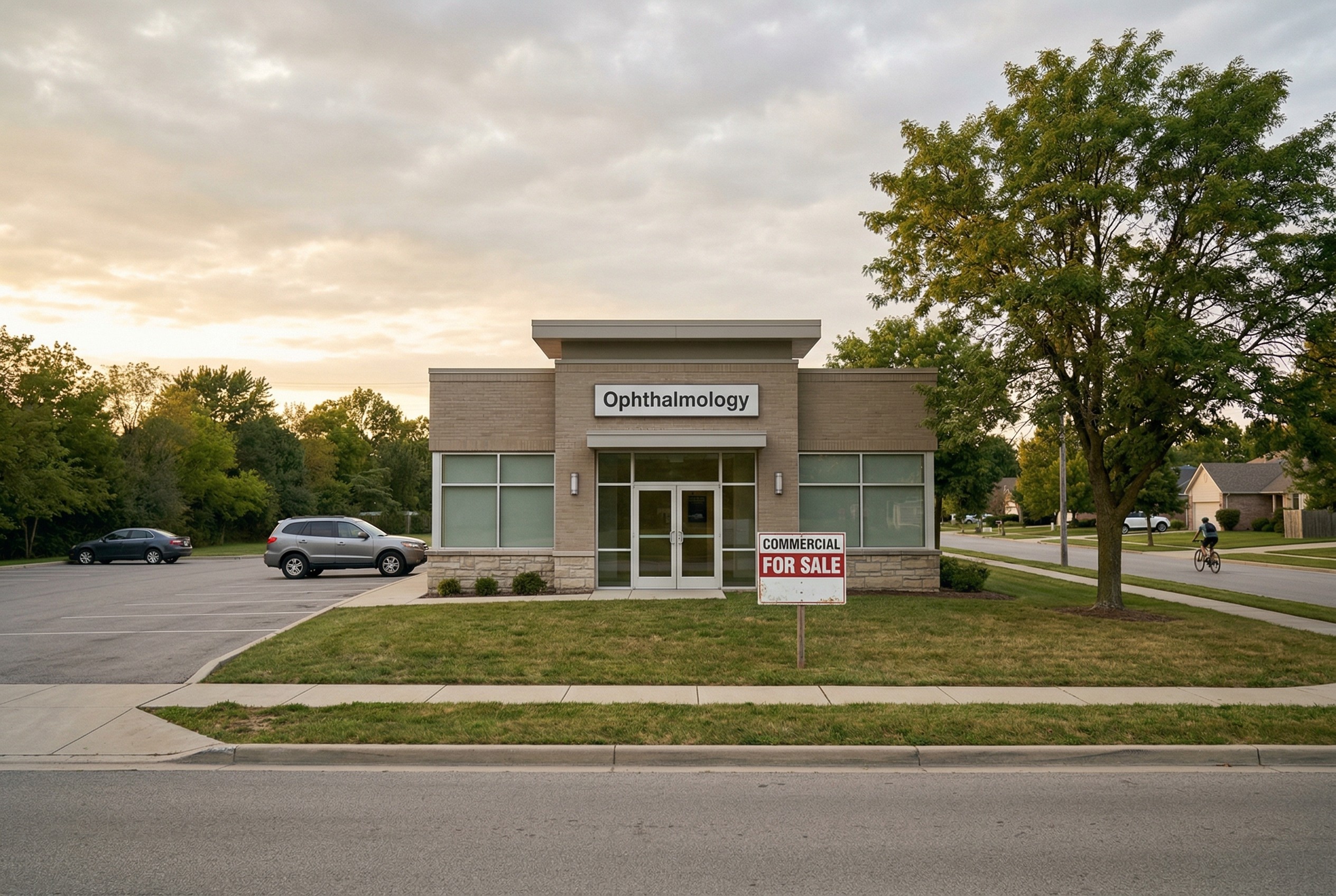
When the buyer pool is this thin, practices sit. 6 months, 12 months and sometimes longer. The physician who expected to be retired by now is still showing up every morning because the alternative is closing the doors and sending letters to 3,000 patients telling them to find a new doctor.
During the months the practice sits on the market, the economics deteriorate. The physician starts pulling back. hours get reduced and complex cases get referred out instead of handled in house. The staff senses the transition coming and the best ones start looking for stability elsewhere. The revenue declines because the physician is disengaging, and a disengaging physician is the beginning of a practice that's worth less than it was when it was listed.
The broker does what brokers do. They adjust the asking price, expand the marketing and reach out to every contact in their database. But, the practice still sits because the problem is that the buyer pool for solo ophthalmology practices at this deal size is nearly non-existent.
The Specialty Gap in Practice Brokerage
The brokerage market for physician practices wasn't built for ophthalmology at this scale. Most healthcare transaction advisors focus on larger deals such as multi-location groups, ASC platforms and PE roll-ups. The firms that handle smaller practice sales tend to be generalists who work across multiple specialties, or dental transition firms that have expanded into adjacent healthcare verticals because the deal mechanics are similar even if the clinical expertise isn't.
These brokers are often competent and professional. The issue is that they're working with a buyer universe that barely exists. A broker can run a perfect process: clean financials, professional marketing, a well organized data room and still end up with zero qualified offers because the structural buyer for a $2 million solo ophthalmology practice hasn't been built yet.
What Sellers Need to Know Before They List
For ophthalmologists planning to sell in the next 5 to 10 years, the implication is direct. The timeline to sale will likely be longer than expected. The number of qualified offers will likely be lower than expected and the valuation will likely be softer than what colleagues received 5 or 10 years ago, because the buyer competition that drove those prices no longer exists at this deal size.
Understanding these dynamics before listing, rather than discovering them after 6 months on the market with no offers, is the difference between a structured transition and fire sale. The physicians who fare best are the ones who start the conversation early, build relationships with a potential acquirer before the listing goes live, and understand that the market for their practice isn't what it was a decade ago.
The market needs a different kind of buyer. An operator specifically built to acquire at this deal size, with the operational infrastructure to manage practices post acquisition, and ability to offer the selling physician a transition that doesn't involve PE ownership, hospital integration, or closing the doors. That buyer exists, but most ophthalmologists approaching retirement don't know it's an option yet.
Educational material only. Figures are illustrative and individual results vary. Images are AI-generated illustrations and do not depict actual Verdira practices, physicians, or patients. See our Disclosures.

Written by
Verdira Team
Verdira is building a permanent home for ophthalmology practices. We write about succession, physician ownership, and the forces reshaping eye care in the United States.
Ready to secure your legacy?
We're here to ensure your hard work is valued and your business thrives as part of Verdira.
Disclosures
The content of this site is for general informational purposes only and is not intended to constitute an offer to sell or a solicitation to buy any security or other asset, or a promise to undertake or solicit business, and may not be relied upon in connection with any offer or sale of securities or other assets.
The content of this site is for general informational purposes only and is not intended to constitute an offer to sell or a solicitation to buy any security or other asset, or a promise to undertake or solicit business, and may not be relied upon in connection with any offer or sale of securities or other assets.
The content of this site is for general informational purposes only and is not intended to constitute an offer to sell or a solicitation to buy any security or other asset, or a promise to undertake or solicit business, and may not be relied upon in connection with any offer or sale of securities or other assets.
© 2026 Verdira Management NY, LLC